
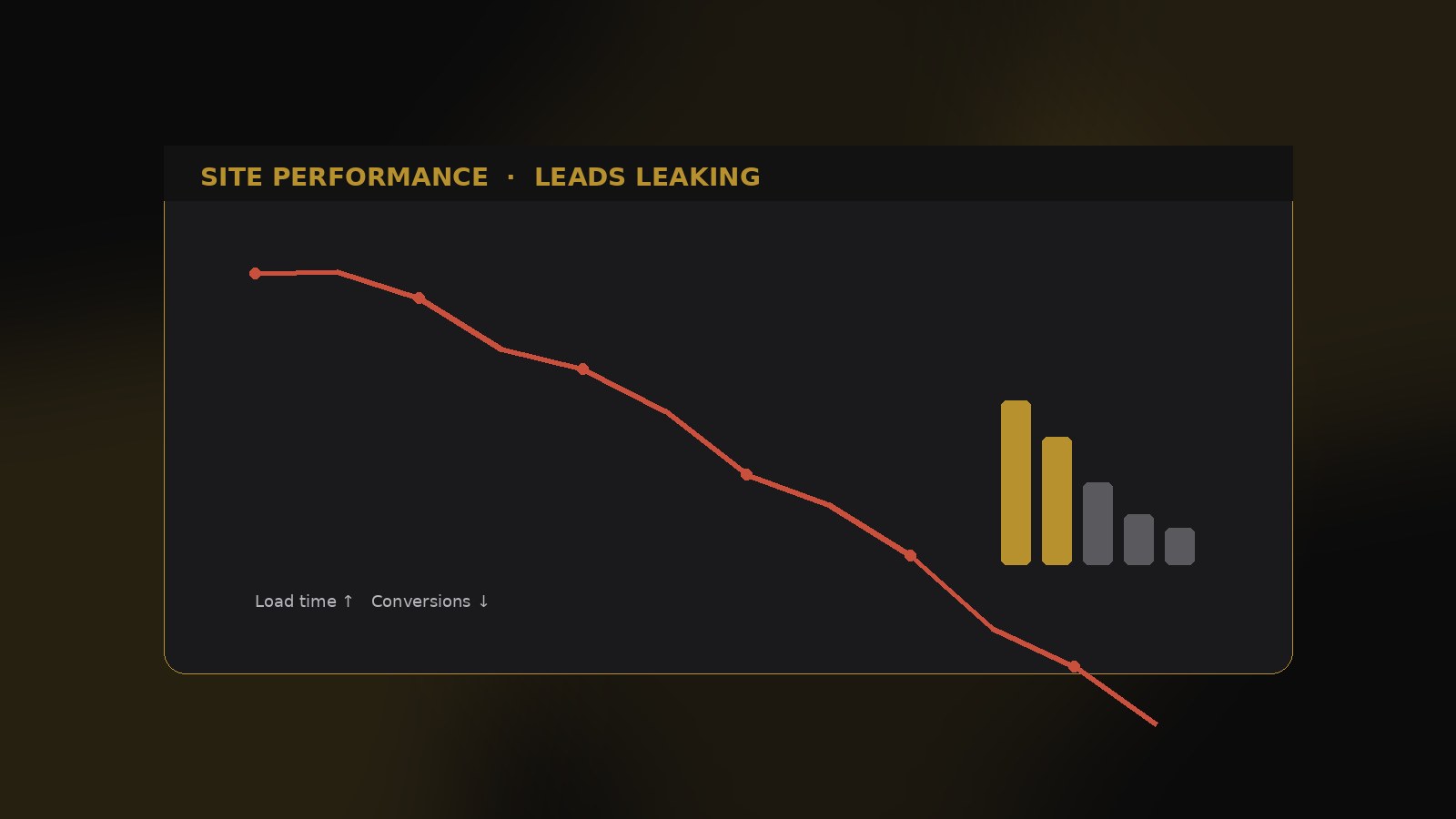
“It works, people can find us, it’s fine for now.” That sentence has quietly cost small businesses more money than almost any other website decision, because “fine” isn’t measured against perfection, it’s measured against whichever competitor’s site loads faster and looks more current.
Here’s how to actually estimate the cost, using industry benchmarks.
The load-speed problem
Google’s own research has found that a majority of mobile visitors abandon a page if it takes longer than three seconds to load. Separately, Portent’s page-speed study found conversion rates drop sharply as load time increases. Sites that load in about one second convert roughly twice as well as sites that take five seconds, which is where many small business websites land.
Example: A business gets 500 monthly visitors. At a 3-second load time, a meaningful share bounce before ever seeing a headline. Even a modest improvement in load speed, such as compressing images, upgrading hosting, or removing unused scripts, can measurably lift how many of those visitors stick around long enough to convert.
The conversion-rate gap
Typical small business website conversion rates (visitor to lead) run in the 2 to 3% range. A poorly built or outdated site often converts under 1%. On 500 monthly visitors:
- At 1% conversion: 5 leads/month
- At 3% conversion: 15 leads/month
That gap, 10 leads a month and 120 a year, isn’t a design preference. It’s leads a business already paid to attract, through ads, SEO effort, or word of mouth, and then lost on the page itself.
The credibility problem
Stanford’s web credibility research found the large majority of people judge a company’s trustworthiness based on website design alone, before reading anything about the business itself. A site that looks outdated, with old fonts, a cramped mobile layout, and no clear next step, quietly signals “outdated service” even when the actual work is excellent.
The mobile factor
More than half of all web traffic today is mobile, and most local searches happen on a phone. A site that isn’t cleanly responsive, with small tap targets, text requiring zoom, and layouts that break on narrow screens, loses a meaningful share of visitors before they ever reach a call-to-action, regardless of how good the desktop version looks.
Running the numbers on your own site
A rough way to estimate the monthly cost:
(Monthly visitors) × (conversion rate gap) × (average value of a lead) = estimated monthly loss
Even conservative assumptions tend to show that a redesign pays for itself within a few months, and every month after that is upside that was previously being left on the table.
FAQ
How do I know if my website is actually hurting my business?
Common signs: high bounce rate on mobile, load time over 3 seconds, no clear call-to-action above the fold, and a design that hasn’t been touched in 3+ years.
Is a full redesign always necessary, or can small fixes help?
Sometimes a handful of targeted fixes, such as image compression, a clearer headline, and a visible CTA, recover much of the loss. A full redesign makes sense when the underlying structure, not just individual elements, is the problem.
How fast does a website redesign typically pay for itself?
It depends on lead value and traffic volume, but for most small businesses, even a modest lift in conversion rate recovers the cost of a redesign within a few months.
Curious what a redesign would actually do for your numbers?
A free discovery call costs nothing and takes 20 minutes. See our Website Design packages if you already know it’s time.
Book a Discovery Call